

Against the dramatic backdrop of Brazil’s iconic coastlines and mounting global uncertainty, the 17th BRICS Summit convened this week, marking a significant turning point in the group’s evolution from symbolic alliance to assertive global actor. Hosted by President Luiz Inácio Lula da Silva, the summit gathered leaders from an expanded BRICS bloc—now eleven members strong—to reaffirm their challenge to Western-dominated global institutions and outline a new vision for a multipolar future.
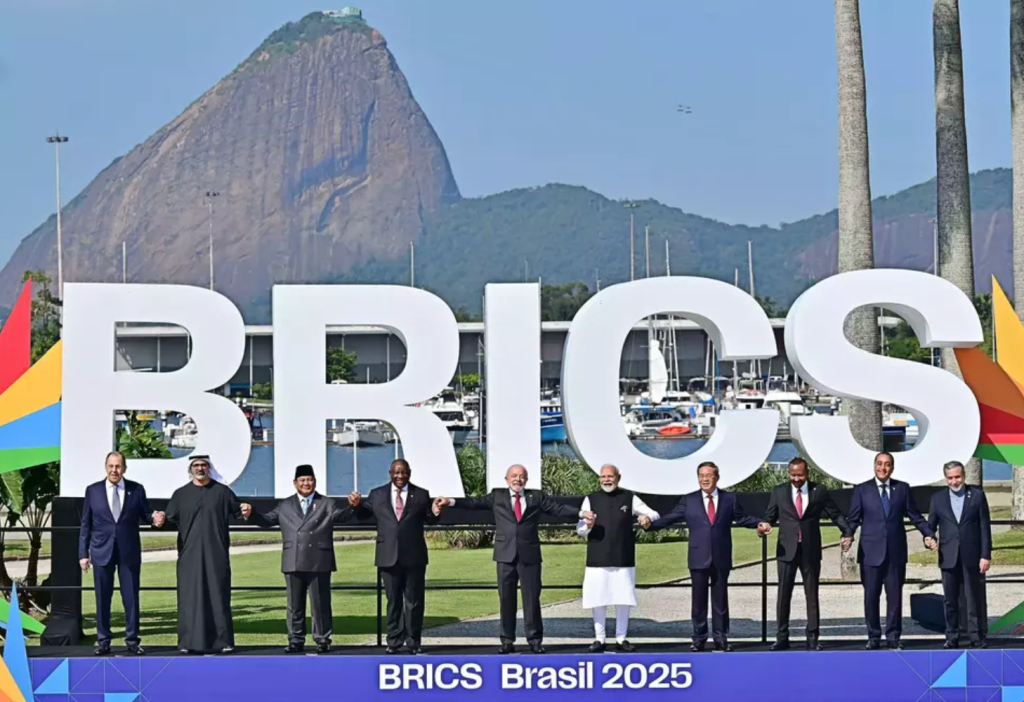
A New Chapter in Global Geopolitics
What began in 2009 as an economic club of emerging powers—Brazil, Russia, India, China, and South Africa—has transformed into a diverse coalition with strategic aspirations. Now joined by Egypt, Ethiopia, Iran, the UAE, and Indonesia, the BRICS+ group used the Rio summit to project collective defiance of Western hegemony. President Lula described the moment as a “rupture from the logic of empire” and called for the reinvention of multilateralism “on terms defined by the Global South.”
Yet, the grandeur of the occasion was tempered by geopolitical realities. Notably absent from Rio were Chinese President Xi Jinping and Russian President Vladimir Putin, who participated virtually amid global scrutiny and diplomatic pressures. Their absence spotlighted the contradictions within BRICS: a group that champions sovereignty while being fractured by competing national interests, sanctions, and global rivalries.
Currency, Credit, and Control
At the core of this year’s summit was a sharpened call to dismantle dollar dominance. The leaders endorsed proposals to accelerate cross-border trade in national currencies, expand the BRICS Contingent Reserve Arrangement, and reinitiate discussions on a BRICS Multilateral Guarantee Agency—a quasi-development bank designed to offer member states financing alternatives free from conditionalities imposed by the IMF or World Bank.
This financial pivot is both ideological and pragmatic. Many BRICS+ members, burdened by debt and wary of dollar volatility, seek financial sovereignty. The bloc’s gradual shift toward alternative payment systems—including a long-debated “BRICS Pay” platform—is aimed at insulating its members from Western sanctions and capital market shocks.
However, experts caution that translating financial ambition into operational power requires trust, infrastructure, and time. “Until BRICS countries truly integrate their financial institutions—central banks, credit systems, and sovereign guarantees—talk of de-dollarization remains rhetorical,” noted Dr. Anika Raman, a development economist based in Delhi.
Trump’s Tariffs and BRICS Pushback
As if on cue, former U.S. President Donald Trump—widely expected to secure the Republican nomination for 2026—intervened in the summit’s narrative by announcing a potential 10% tariff on BRICS countries, accusing the bloc of “economic warfare against the American people.” The remarks were met with swift condemnation.
In one of the summit’s most quoted lines, Lula fired back: “The world no longer bows to emperors. We build coalitions, not colonies.”
While BRICS leaders sought to play down anti-Western sentiment, the growing friction with Washington is no longer beneath the surface. With Africa, Asia, and the Middle East looking for non-aligned alternatives amid renewed Cold War dynamics, BRICS is positioning itself as the new “third way” in global affairs.
An Ambitious, Uneven Bloc
The final Rio Declaration, a sweeping 126-point communiqué, touched on nearly every dimension of global governance—from AI regulation and peace in Gaza, to sustainable development and food security. It called for UN Security Council reform, greater climate finance for developing nations, and concrete commitments to South-South knowledge exchange.
Yet, behind the unity lies asymmetry. China towers economically over the other members. India remains cautious of alignment with China and Russia. Iran and Ethiopia bring diplomatic baggage. Indonesia’s entry hints at Southeast Asia’s growing sway—but also signals potential dilution of consensus.
Indeed, the BRICS bloc is evolving into more of a platform than a compact—a loose coalition of states united by discontent with the current order but divided over what should replace it.
What Comes Next?
India will chair the 2026 summit. Analysts predict New Delhi will steer BRICS toward practical cooperation over grandstanding: emphasizing digital public goods, technology transfers, and disaster resilience.
Meanwhile, Brazil hopes to use momentum from the summit to shape climate negotiations at COP30, to be hosted later this year in Belém. If BRICS can define a collective Global South climate agenda—financed through its own instruments—it may become a credible alternative to Western-led climate diplomacy.
Conclusion:
The Rio summit signaled more than the growing weight of the BRICS bloc—it underscored the fracturing of the post-Cold War consensus. In a world increasingly defined by rival visions of order, BRICS is no longer a footnote. Whether it becomes a true counterweight or collapses under its own contradictions will define the next chapter of global politics.