

About AAI
The Imperative
Why the Africa–Asia Institute?
Founding Vision and Global Imperative
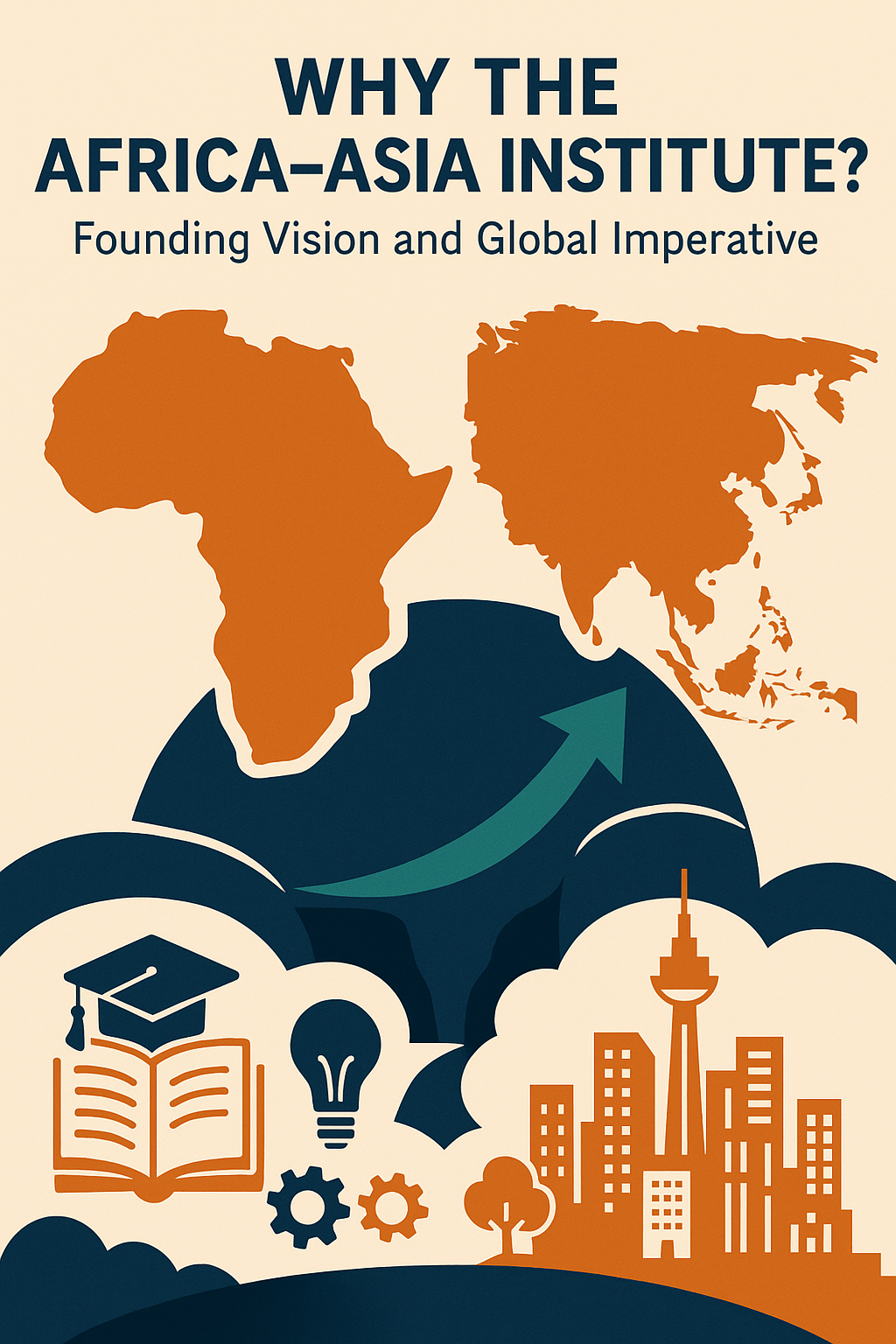
Africa and Asia together are home to more than 75% of the world’s population. They are the continents where the majority of the world’s youth live, where megacities are rising, where the next frontiers of innovation, agriculture, and industrialization are unfolding. Yet, the global voice of Africa and Asia does not reflect this demographic and developmental weight. In international institutions, in research leadership, and in global agenda-setting forums, these regions are still often marginalized or spoken for by others.
The Africa–Asia Institute (AAI) was established to reverse this imbalance—not with rhetoric, but through practical cooperation. It was founded to institutionalize cross-continental collaboration in education, diplomacy, business, science, culture, and sustainability. The idea is simple but urgent: if Africa and Asia are to shape their futures, they must do so together—and they must do so through their own frameworks, institutions, and voices.
Despite the population and shared history of anti-colonial solidarity, the two regions remain under-connected. When African or Asian students study abroad, they seldom consider universities in each other’s regions. The pipelines of academic exchange, business networking, policy dialogue, and innovation are still dominated by North–South flows. The question arises: Have we done enough to build the South–South linkages that our future requires? The answer, thus far, is no.
Few African and Asian universities have signed meaningful memoranda of understanding for long-term institutional cooperation. Few national research agencies co-fund joint projects. Few cultural centers showcase each other’s artistic or philosophical traditions. This gap between potential and practice is what AAI was created to address. It is not a think tank. It is a platform. A space. A mechanism. A response to a long-standing void.
Why Addis Ababa?
AAI is headquartered in Addis Ababa, not by coincidence but by conviction. Addis Ababa is the diplomatic capital of Africa, home to the African Union and over 120 embassies and international institutions. It is a city of historical symbolism—a city that resisted colonization, hosted the Bandung generation, and championed Pan-Africanism. Located at the crossroads of African diplomacy and political thought, Addis Ababa provides AAI with a strategic vantage point.
From Addis, AAI connects not only North to South and East to West, but Africa to Asia and the Global South to itself. Ethiopia’s long-standing engagement with Asia—from trade routes to philosophical exchange—makes it an ideal bridge.
What Needs to Be Done? A Call to Action
To realize the mission of the Africa–Asia Institute, governments, businesses, philanthropists, and academic institutions must act decisively.
- Governments in both regions should include Africa–Asia cooperation in their foreign policy priorities, fund student mobility programs, and support joint research institutions.
- Business leaders and chambers of commerce must invest in South–South commerce facilitation, innovation parks, and business-to-business platforms managed by AAI.
- Philanthropic foundations and development partners should fund long-term institutional infrastructure—not just one-off projects—and provide endowments for youth fellowships, women-led enterprises, and environmental research.
- Universities and think tanks must commit to formal collaboration through research centers, joint degree programs, and shared knowledge systems hosted or coordinated by AAI.
AAI is not a substitute for diplomacy or development cooperation. It is the mechanism that makes them meaningful across Africa and Asia. In a world fractured by geopolitical competition and ecological crises, the future demands a rebalancing. That rebalancing begins here—with African and Asian institutions working together, on equal terms, in a shared future.